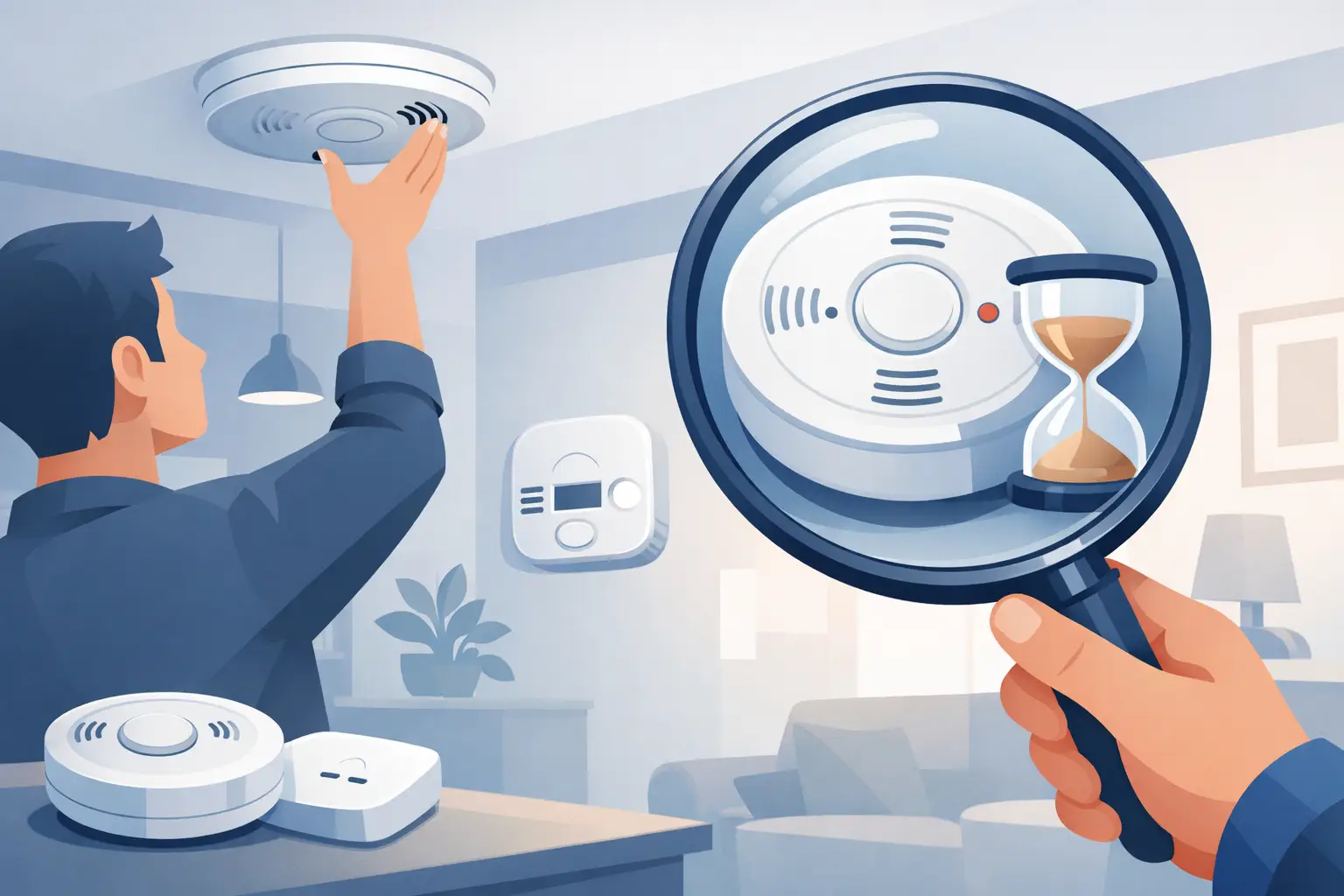
A smoke alarm can still beep when you press the test button and still be too old to protect your family properly. That is why knowing how to check alarm expiry dates matters. In Queensland, an alarm that has reached the end of its service life is not something to put off until the next inspection, sale or lease renewal. It needs replacing.
Most residential smoke alarms have a maximum service life of 10 years from their date of manufacture. Heat, dust, insects, humidity and normal wear slowly affect the sensing chamber. Brisbane conditions are not kind to cheap alarms, particularly in ceiling spaces and humid coastal suburbs. A fresh battery cannot fix an expired detector.
How to check alarm expiry dates properly
Start by looking at the alarm itself. The date is usually printed on a label on the back, side or inside the mounting plate area. You may need to twist the alarm anticlockwise to remove it from the base and read the label. Do not pull on the wiring.
Look for one of these details:
- a manufacturing date, often marked as MFD, DOM or Date of Manufacture
- a replacement date, expiry date or “replace by” date
- a batch code or serial number that includes the manufacture date
- a QR code that can identify the model and production details
If the alarm has a clear “replace by” date, use that date. If it only shows a manufacture date, add 10 years unless the manufacturer’s instructions specify a shorter period. For example, an alarm made in March 2016 should be replaced by March 2026, even if its test button still sounds the siren.
Write the date down or take a photo on your mobile while the alarm is off the base. This is especially useful where several alarms are installed throughout the home. It stops one old unit being missed during a rushed pre-sale or tenancy compliance check.
Do not confuse the battery date with the alarm date
This catches plenty of homeowners out. A replaceable battery may have its own expiry date printed on the casing. That date tells you about the battery, not the smoke alarm sensor.
Likewise, a 10-year lithium battery alarm is not necessarily new because the battery is advertised to last 10 years. The full alarm unit still has a 10-year service life from manufacture. If it was sitting on a shelf for two years before installation, those two years still count.
The sensor inside the alarm is the critical part. Once it reaches its end-of-life date, replace the whole unit.
Where to find the date on different alarm types
For a battery-powered alarm, gently twist it off its ceiling base. The manufacture date is commonly on the rear label, near the model number and electrical rating.
For a hardwired smoke alarm with battery backup, the label is also usually on the back of the unit. Take extra care. The alarm may be connected to 240V wiring, even when the power is switched off at the wall. If the alarm will not release easily, has exposed wiring, or you are unsure how it is connected, leave it alone and have a licensed electrician check it.
Interconnected alarms should be checked one by one. Do not assume that because one alarm was recently installed, every alarm in the system is the same age. Homes are often upgraded in stages, leaving an older alarm in a hallway, bedroom or garage area.
If paint, dust or yellowing makes the label unreadable, treat that as a warning sign. An alarm with no legible date, unknown history or an obsolete model is not a reliable compliance choice. Replacing it is usually safer and more cost-effective than guessing.
A test button is not an expiry test
Pressing the test button is still worthwhile. It confirms the alarm has power, the sounder works and, for interconnected systems, other alarms respond as they should. It does not prove the smoke sensor can detect a developing fire.
Smoke alarms are life-saving electronic devices, not permanent fixtures. Their sensing components degrade over time. An old alarm might pass a button test, chirp occasionally and look fine from the floor, yet respond too slowly when smoke enters the chamber.
That is the risk with relying on an alarm beyond its rated life. The warning may come when there is no time left to waste.
What expired alarms mean for Queensland homes
Queensland smoke alarm rules are strict because early warning saves lives. Existing homes, rental properties and properties being sold have different obligations depending on the situation, but the core expectation is clear: smoke alarms must be compliant, functional and correctly located.
For homes being sold, landlords and rental properties, the required standard generally includes photoelectric smoke alarms in prescribed locations, interconnected alarms and hardwired power where it can be installed. Where hardwiring is not practicable, a 10-year non-removable battery alarm may be used in the appropriate circumstances.
An expired alarm can undermine an otherwise compliant setup. You may have the right number of alarms in the right locations, but if one has passed its service life, it is time to replace it. This can become a problem during a property sale, a tenancy handover or an annual safety check, but the bigger issue is the people sleeping under that roof.
Older ionisation alarms are another red flag. They are not the preferred choice under modern Queensland requirements and are more prone to nuisance alarms from cooking. A nuisance alarm gets ignored or disabled. A quality photoelectric alarm is designed to provide more useful warning of smouldering fires, which are common in residential settings.
Check the full system, not just one ceiling alarm
Once you have found one expiry date, check every smoke alarm in the property. Bedrooms, hallways, storeys and connecting paths can all have separate devices. Multi-level homes and additions are particularly likely to contain mixed alarm ages and types.
As you check, watch for signs that a replacement or upgrade is overdue: yellowed plastic, paint over the vents, missing batteries, repeated false alarms, cracked covers, loose mounting bases or alarms that do not trigger the rest of an interconnected system.
It is also worth checking whether the alarms match. A mix of old battery units, newer hardwired units and different brands can create uncertainty around interconnection and compliance. Sometimes replacing one expired device is enough. In other homes, a coordinated system upgrade is the sensible option because it removes the weak links and avoids repeated call-outs over the next few years.
Cheap replacements can look like a saving until humidity, poor battery performance or incompatible interconnection causes another problem. The right answer depends on your wiring, property layout, existing alarm locations and the age of the whole system.
When to call a licensed smoke alarm electrician
You can read a visible label and press a test button. But replacement of hardwired alarms, changes to alarm locations and work on interconnected systems should be handled properly by a licensed electrician.
Call for professional help if your alarms are hardwired, you cannot find a readable date, an alarm has expired, the system is not interconnected, or you are selling, leasing or settling on a property and need certainty. A specialist can identify the model, confirm the age, assess whether the setup meets Queensland requirements and replace outdated alarms with suitable photoelectric units.
The Smoke Alarm Sparky helps Brisbane and South East Queensland homeowners, landlords and sellers get this done without guesswork. The focus is not on fitting the cheapest alarm available. It is on a compliant system that is suited to local conditions and built to keep working when it counts.
Set a reminder to check your alarm dates at the same time each year you test your alarms. If any unit is approaching 10 years old, arrange replacement before it becomes an urgent compliance problem or, worse, a safety failure in the middle of the night.