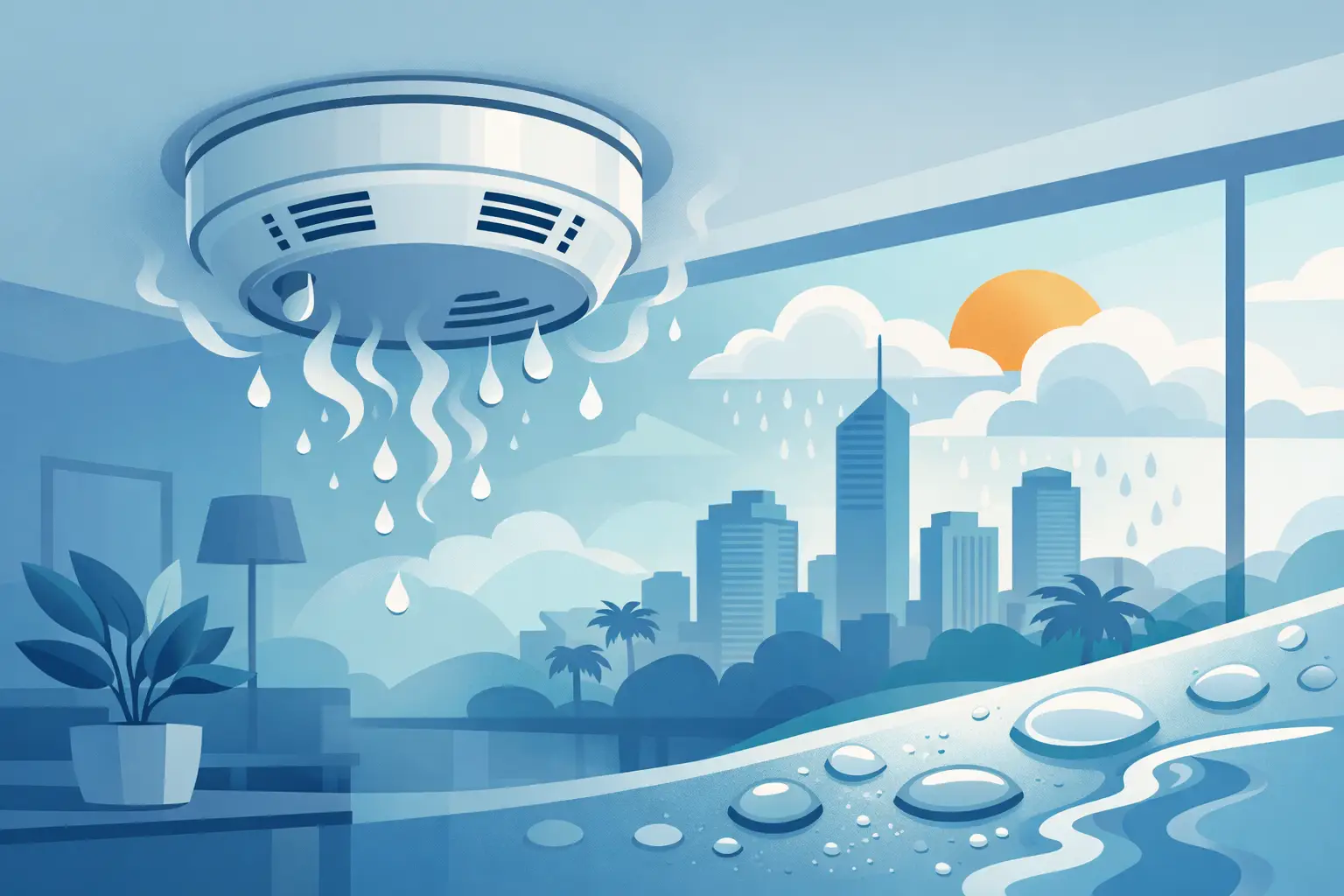
Brisbane summers do not just test your air conditioner. They can test your smoke alarms too. Understanding the humidity effects on smoke alarms matters because a false alarm at 2 am is frustrating, but an alarm that has been ignored, removed or damaged by moisture is a serious safety risk.
High humidity, steam, condensation and heat are common across Brisbane, Redland, Logan and the bayside suburbs. The right alarm, installed in the right position, is built to cope with normal local conditions. The wrong product or a poor installation can leave you dealing with repeated nuisance alarms, corrosion, non-compliance and a system your family no longer trusts.
Humidity effects on smoke alarms: the real issue
Humidity is water vapour in the air. On a muggy Queensland day, it is present throughout the home, especially after showers, cooking, drying clothes indoors or running a hot dishwasher. Humidity alone does not automatically mean your smoke alarm is faulty. Quality photoelectric alarms are designed for ordinary household humidity.
The problem starts when moisture becomes dense enough to enter the sensing chamber, forms condensation, or combines with dust, insects and airborne cooking residue. That can interfere with the alarm's ability to distinguish smoke from other particles in the air.
Photoelectric smoke alarms use a light beam inside a sensing chamber. When smoke enters, the light scatters and triggers the alarm. Fine water droplets from steam, heavy condensation or humid air carrying dust can sometimes scatter that light in a similar way. The result may be a false alarm.
That does not mean an alarm should be moved, covered or disconnected. Those shortcuts are dangerous, and they can leave a Queensland property non-compliant. Repeated false alarms are a reason to investigate the cause properly.
Humidity is not the same as shower steam
A humid day and a bathroom full of shower steam are very different conditions. Most correctly installed alarms should tolerate the first. The second can overwhelm an alarm installed too close to a bathroom door, laundry or kitchen.
Steam is made of visible water droplets. It travels quickly through hallways when a bathroom door is opened after a hot shower. In compact units, homes with poor ventilation, or houses where alarms have been placed without proper planning, that burst of moisture can set off a nearby alarm.
Cooking vapour creates a similar problem. Frying, grilling and boiling kettles can send steam and fine particles towards an alarm. It may be tempting to blame the alarm, but placement is often the real issue.
Why Brisbane homes need the right alarm and placement
Queensland smoke alarm rules are clear for homes being sold, leased or renewed: compliant photoelectric alarms must be installed in the required locations, interconnected, and powered by hardwiring or a non-removable 10-year battery where applicable. Owner-occupied homes also need to meet the full Queensland requirements by 1 January 2027.
Compliance is not simply a matter of putting an alarm on the ceiling wherever there is space. An alarm has to be close enough to sleeping areas to wake occupants, while avoiding unsuitable positions that expose it to excessive steam, cooking fumes, air-conditioning drafts or dead-air spaces.
This is where cheap, one-size-fits-all installations create headaches. A low-cost battery alarm installed near a bathroom may seem fine on day one, then start sounding during summer showers. Homeowners get fed up, remove the battery, and suddenly the home has no working warning where it matters most.
A licensed electrician assesses the dwelling layout, sleeping areas, storeys, existing wiring and required interconnection. That is how you get protection that works when there is a real fire, rather than a system that becomes background noise.
Condensation can cause longer-term damage
False alarms are the obvious symptom, but moisture can create less visible issues over time. Condensation can affect electrical contacts, corrode components and encourage dust to stick inside the alarm. In coastal and bayside areas, salt-laden air can add another layer of stress to poorly made or ageing products.
Hardwired alarms with battery backup are a strong long-term option for many Brisbane homes, but they still need correct installation and quality components. A hardwired system is not immune to poor placement, moisture exposure or product age.
If an alarm is chirping, intermittently faulting or alarming without a clear cause, do not assume a new battery will fix it. The unit may be at end of life, contaminated, poorly located or affected by an electrical fault. Smoke alarms are life-safety devices, not something to keep patching until they finally stop working.
Signs humidity may be affecting your smoke alarm
Humidity-related alarm problems tend to follow a pattern. The alarm may sound after hot showers, during heavy rain, when the house is closed up, or after cooking. You may notice the problem is worse in summer or occurs in the early morning when condensation is more likely.
A false alarm should never be dismissed without checking for fire first. Once you have confirmed there is no danger, take note of what was happening in the home. Was someone showering? Was a bathroom door open? Was there steam from the kitchen, or has the alarm recently started chirping during wet weather?
One isolated event may simply be a burst of steam. Frequent alarms, error sounds, yellowing, physical damage or an alarm nearing ten years old need closer attention. So does an alarm that goes silent when other interconnected alarms activate. Interconnection is there to give everyone in the home the earliest possible warning, not just the person nearest the fire.
How to reduce nuisance alarms without reducing protection
Start with everyday moisture control. Use bathroom exhaust fans during and after showers, keep bathroom doors closed until steam clears, and use rangehood ventilation while cooking. Good ventilation helps the home as well as the alarm.
Keep alarms clean, but be careful. Lightly vacuum around the alarm vents as part of routine cleaning if the manufacturer's instructions allow it. Do not spray cleaning products, insect spray, paint or deodorant directly onto an alarm. Those products can contaminate the sensing chamber and cause faults.
Test every smoke alarm regularly using the test button. A test confirms the alarm can sound and, in an interconnected system, that the other alarms respond. It does not prove that placement is suitable or that the sensing chamber is clean, which is why a recurring false alarm still deserves professional attention.
Most importantly, never remove a battery, tape over an alarm or leave it disconnected because it is annoying. A fire can start in the hours after a nuisance alarm, when everyone assumes the problem has passed. The period when an alarm has been disabled is exactly when your household is unprotected.
When replacement is the safer option
Smoke alarms do not last forever. Many units have a service life of around ten years, even if they still appear to work when tested. Sensors age, contamination builds up and Queensland compliance requirements may have changed since the original alarms were fitted.
Replacement is often the sensible answer if the alarms are old, incompatible with each other, repeatedly affected by moisture, not photoelectric, not interconnected, or powered by removable batteries where a compliant 10-year battery or hardwired option is required. It is also worth checking after renovations, extensions or changes to bedroom layouts.
The Smoke Alarm Sparky installs Queensland-compliant photoelectric systems selected for long-term reliability in local conditions, with licensed installation and a 10-year full replacement warranty. That matters when you want the job done once, not another cheap alarm replacing a cheap alarm next summer.
Do not let a false alarm become a blind spot
Humidity can be managed. Poor placement, ageing alarms and non-compliant installations should not be tolerated. If your alarms regularly sound during showers, storms or cooking, arrange an inspection before frustration leads someone in the household to disable them.
A properly planned, interconnected photoelectric system gives your family the warning they need while reducing avoidable nuisance alarms. In a Brisbane home, that is not an upgrade to put off until later. It is practical protection for the next hot, wet night.