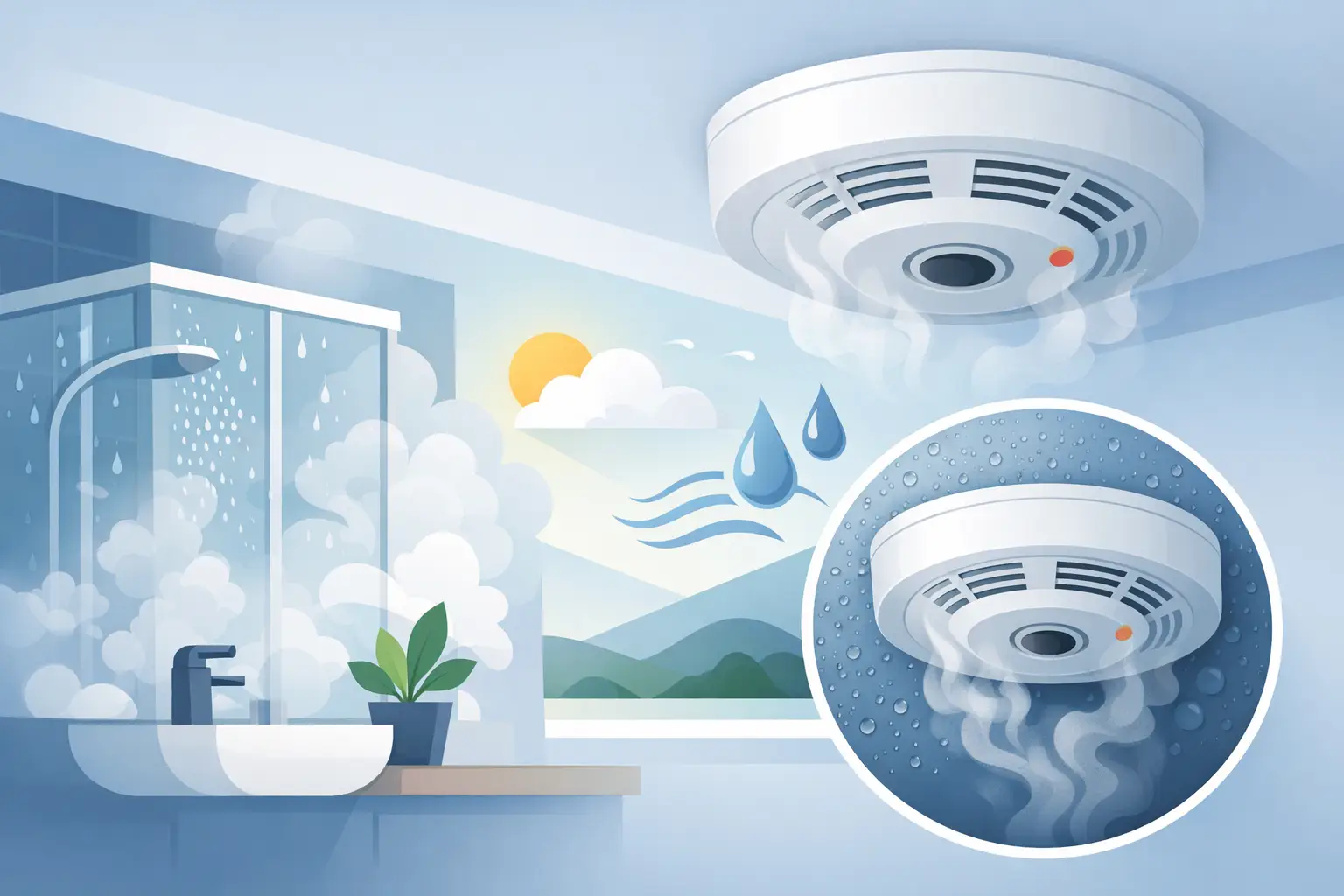
You usually notice a bad smoke alarm setup at the worst possible time - 2am, bathroom steam in the hallway, everyone jolted awake, and no real fire in sight. That is exactly why this humidity resistant smoke alarm guide matters in Brisbane and across South East Queensland. Our climate is hard on cheap alarms, and when moisture, dust and heat are part of daily life, the wrong alarm can become unreliable fast.
For homeowners, landlords and anyone preparing a property for sale or lease renewal, this is not just about convenience. It is about safety, legal compliance and avoiding the false economy of installing alarms that are not built for local conditions. A smoke alarm that chirps, false alarms or fails early is not a bargain. It is a risk.
Why humidity matters more in Brisbane homes
Queensland homes cop a lot - humid summers, coastal air in bayside suburbs, condensation near bathrooms and laundries, and ceiling spaces that get brutally hot. Moisture does not always destroy a smoke alarm overnight, but it can interfere with sensor performance over time. That leads to nuisance alarms, reduced sensitivity, corrosion in poor-quality units and a shorter service life.
This is where many people get caught. They buy a low-cost alarm from a hardware store, install it where the packet suggests, and assume the job is done. Then the alarm starts going off after showers, cooking or a sticky run of summer weather. Some people take the battery out. Others ignore it. Both outcomes are dangerous.
Humidity resistance is not about making an alarm waterproof. It is about choosing a quality unit designed to perform properly in Australian homes where moisture and heat are part of the environment. That matters even more when the alarm is part of a legally required interconnected system.
What a humidity resistant smoke alarm guide should actually tell you
A proper humidity resistant smoke alarm guide should not just say buy a better alarm. It should explain what type of alarm works best, where it should be installed, and why installation quality matters just as much as the product itself.
In Queensland, photoelectric smoke alarms are the standard for residential compliance, and for good reason. They are generally better at detecting smouldering fires, which are common in home fire scenarios, and quality photoelectric units are less prone to nuisance alarms than old ionisation alarms. That does not mean every photoelectric alarm is the same. Cheap units still fail. Cheap units still false alarm. Cheap units still die early in humid conditions.
The right choice is a compliant photoelectric alarm from a reputable manufacturer, installed in the correct location by a licensed electrician who understands Queensland legislation and local housing conditions. That is the difference between ticking a box and actually protecting the people inside the house.
The problem with cheap alarms in humid conditions
Budget alarms often look fine on the shelf. The issue shows up later. Inferior sealing, lower-grade components and poor sensor stability can all become obvious once the alarm has spent months dealing with moisture, ceiling heat and day-to-day household air movement.
That means more call-backs, more false alarms and more replacements. If you own an investment property, that turns into tenant complaints and avoidable expense. If you are selling, it can become one more problem raised during the transaction. If it is your family home, it is worse - you cannot afford doubt when an alarm sounds.
How to choose the right alarm for humid areas
Start with compliance, because there is no point installing a product that does not meet the rules. Queensland homes covered by current legislation need photoelectric smoke alarms that comply with Australian Standards, are interconnected where required, and are correctly located throughout the home.
From there, focus on reliability. Look for alarms known to handle humid residential environments, not generic bargain units with little track record. Hardwired alarms with battery backup are often the strongest long-term option for occupied homes because they provide stable power and form part of a permanent compliant system. In some situations, 10-year lithium battery alarms may suit the property, but only if they are appropriate for the layout and legal requirements.
You also want alarms backed by a real warranty, not vague packaging promises. A long replacement warranty says a lot about whether the installer and manufacturer expect the product to last.
Placement matters as much as product quality
Even a good alarm can become a nuisance if it is installed in the wrong spot. Put it too close to a bathroom door, and steam can trigger it. Too near a kitchen, and cooking fumes may set it off. Too close to a ceiling fan or air-conditioning outlet, and airflow can affect how smoke reaches the sensor.
This is why DIY advice only gets you so far. Compliance placement is one issue. Real-world performance is another. In humid homes, those two need to work together.
A licensed smoke alarm specialist will look at the floorplan, bedroom locations, travel paths, ceiling types and likely moisture sources. That is how you reduce false alarms without compromising fire detection.
Compliance is not optional
A lot of property owners still assume smoke alarm rules are flexible. They are not. Queensland has clear requirements, and they affect owner-occupied homes, rental properties and homes being sold. If your alarms are outdated, not interconnected, not photoelectric or not correctly positioned, you may not be compliant.
That has real consequences. For landlords, it can mean exposure to disputes, failed obligations and serious safety concerns. For sellers, it can create issues during contract stages. For homeowners, the bigger problem is simple - non-compliant usually also means under-protected.
Humidity complicates this further because poor-performing alarms may technically exist on the ceiling while doing a poor job in practice. Compliance done properly means choosing products fit for local conditions, not just the cheapest option that can be screwed into place.
Signs your current alarms are not coping
Most homes give warning signs before a total failure. Repeated false alarms in humid weather, random chirping, yellowing old plastic housings, alarms older than 10 years, mismatched brands across the house, or units installed only in hallways are all red flags.
Another common issue is partial upgrades. One or two newer alarms might have been added over time, but the full system is still not interconnected or does not meet current spacing and location requirements. That patchwork approach is common in Brisbane homes and rarely holds up when you inspect it properly.
If you are not sure, assume nothing. Get the setup checked before it becomes a legal problem or a safety failure.
Why professional installation pays for itself
This is one of those jobs where doing it twice costs more than doing it properly once. A licensed electrician who specialises in smoke alarms will not just fit the alarms. They will identify what the law requires for your property, select suitable products for the conditions, install them correctly, test interconnection, and make sure the system is ready to do its job.
That matters in humid areas because performance depends on the whole system - sensor quality, placement, wiring where relevant, and product lifespan. It also matters because if there is a problem later, you want accountability. Not a box from a shelf. Not guesswork. A proper installation.
For Brisbane and South East Queensland homes, The Smoke Alarm Sparky focuses on exactly that point - compliant smoke alarm systems built for local conditions, installed by licensed electricians, with long-term reliability in mind.
The smarter way to think about cost
People often compare the upfront price of premium alarms with the cheapest available option. That is the wrong comparison. The real comparison is cheap now versus reliable for years.
If a low-cost alarm starts false alarming, gets disabled, fails early or needs replacing again after another wet summer, it was never cheaper. Add the risk of non-compliance, tenant complaints, or a failed sale condition, and the numbers get worse.
A better-quality alarm system costs more at the start because it is supposed to. You are paying for compliance, durability, correct installation and fewer headaches later. In a climate like ours, that is not overspending. That is common sense.
If your home is in Brisbane, Redland, Logan, Beenleigh, Wynnum, Capalaba, Ormiston or nearby, the safest move is simple: choose smoke alarms that are built to handle humidity, and have them installed properly the first time. Your ceiling space does not care about bargain pricing, and neither does a fire.