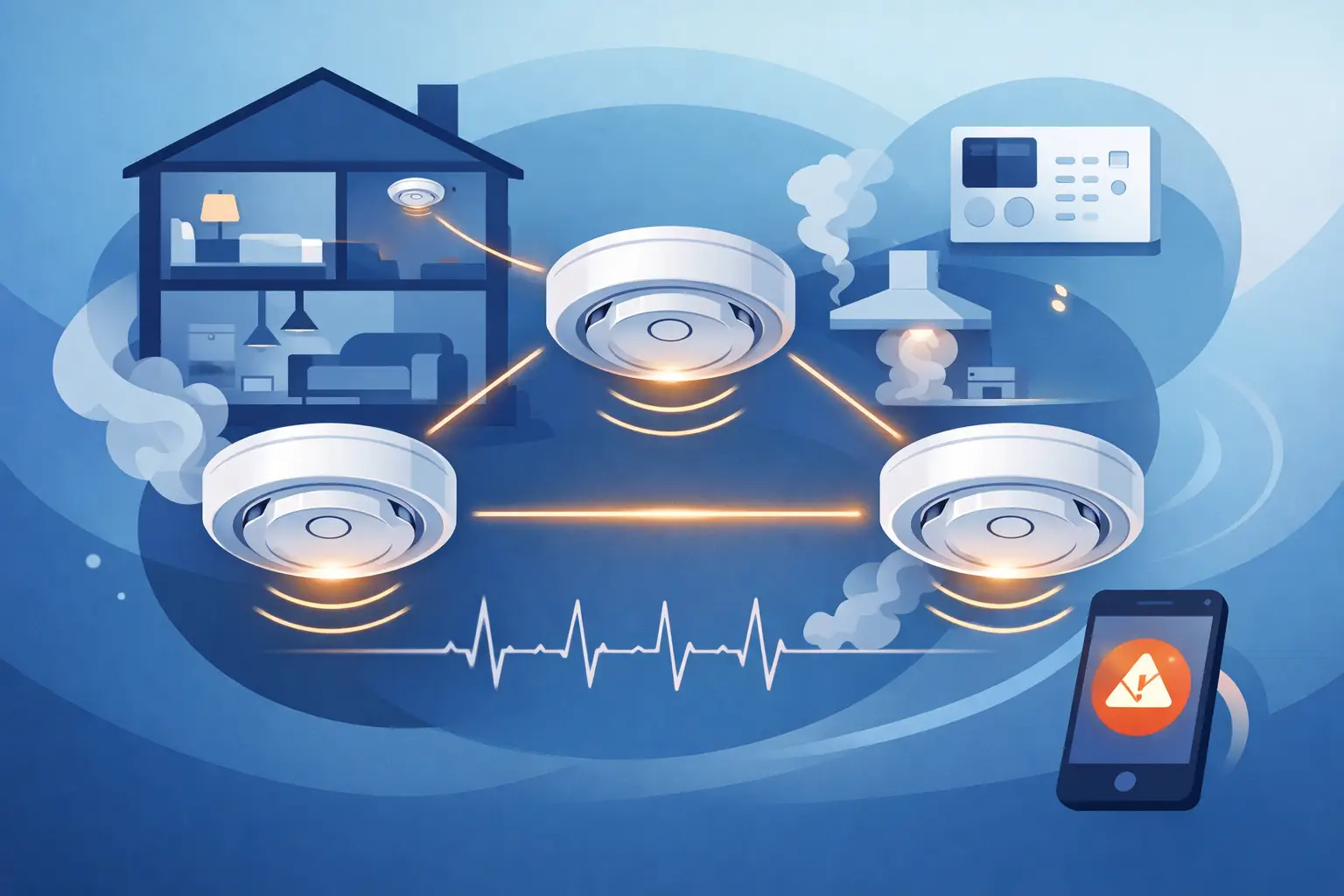
You do not get much warning in a house fire. That is exactly why people ask how are smoke alarms interconnected – because a single alarm going off in one room is not enough if your family is asleep at the other end of the house. In a compliant setup, when one alarm detects smoke, every connected alarm sounds. Fast. Loud. Everywhere.
That is the difference between hearing a threat early and hearing it too late.
How are smoke alarms interconnected in a home?
Interconnected smoke alarms are designed to communicate with each other so the whole system responds as one. If smoke is detected in the bedroom hallway, the alarm in the main bedroom sounds. The one near the living area sounds. The one outside the kids’ rooms sounds. The result is simple – everyone in the house gets the same warning at the same time.
There are two main ways this happens. The first is hardwired interconnection, where alarms are physically linked through the home’s electrical wiring. The second is wireless interconnection, where compatible alarms send a signal by radio frequency. Both can achieve whole-home activation when installed properly, but the right option depends on the property, the existing wiring, and what is needed to meet Queensland requirements.
For many Brisbane homes, hardwired photoelectric smoke alarms with battery backup are the strongest long-term solution. They are stable, compliant, and better suited to permanent residential protection. Wireless interconnection can also be a practical option in some homes, especially where running new cable would be invasive or costly. But it is not a one-size-fits-all decision. Compliance comes first.
What happens when one alarm detects smoke?
The process is quick. One smoke alarm senses combustion particles in the air. If it is a photoelectric alarm, it is designed to respond more effectively to the smouldering fires common in homes, such as upholstery, bedding, or electrical faults behind walls. Once that alarm goes into alert mode, it sends a signal to the other interconnected alarms.
If the system is hardwired, the signal travels through the interconnect wire. If it is wireless, the signal is transmitted between paired alarms. Either way, the result should be the same – all alarms activate together.
That matters more than most people realise. Fires do not start where people are most likely to hear them. A fire might begin in the garage, a lounge room, or a hallway while the occupants are asleep behind closed doors. Interconnection gives you a better chance of hearing the alarm before smoke spreads through the house.
Why interconnected alarms matter more than standalone alarms
A standalone alarm only protects the space around it. That is better than nothing, but it leaves dangerous gaps. If one cheap battery alarm is fitted in a hallway and the fire starts in a back bedroom, you are relying on distance, open doors, and luck.
Interconnected alarms remove that weak point. They turn separate devices into a system. That is exactly what modern smoke alarm laws are trying to achieve – early warning throughout the home, not just in one spot.
For Queensland homeowners, landlords, sellers, and buyers, this is not just about best practice. It is about legal compliance. If your property needs to meet current smoke alarm legislation, the alarms must do more than make noise. They must be correctly located, photoelectric, and interconnected where required.
Hardwired vs wireless interconnection
This is where many property owners get stuck. They know they need interconnected alarms, but they are not sure how those alarms should be connected.
Hardwired interconnected smoke alarms
A hardwired system links the alarms through the home’s electrical circuit and interconnect cable. These alarms are powered by mains electricity and include battery backup in case of power failure.
This setup is often the preferred choice for owner-occupied homes and major compliance upgrades because it offers dependable long-term performance. Once installed by a licensed electrician, it is a solid permanent solution. It also reduces the chance of someone removing batteries or fitting the wrong replacement unit later.
The trade-off is installation complexity. In some homes, especially older brick properties or homes with difficult roof access, running cable can take more labour. That does not mean it should be avoided. It just means the job needs to be assessed properly.
Wireless interconnected smoke alarms
Wireless alarms communicate without a physical interconnect cable. They are still installed as a coordinated system, but the signal passes by radio link between compatible units.
This can be useful in finished homes where cabling would cause unnecessary disruption, or where a practical retrofit is needed without opening ceilings and walls. But wireless does not mean casual. The devices still need to be compliant, correctly positioned, professionally selected, and installed to work reliably in the local environment.
Cheap off-the-shelf products are where people come unstuck. In Brisbane’s humidity, low-grade alarms can become unreliable far sooner than expected. The result is nuisance alarms, dropouts, sensor failure, or systems that do not hold up over time. Saving a few dollars upfront can leave you with a non-compliant property and a false sense of security.
How are smoke alarms interconnected under Queensland rules?
Queensland’s smoke alarm laws are strict for a reason. The goal is to make sure people are warned early enough to escape. That means the type of alarm, where it is installed, and how it communicates with the others all matter.
For homes captured by current requirements, smoke alarms must generally be photoelectric, comply with the relevant product standard, be no older than 10 years, and be interconnected. They also need to be installed in the required locations, including each bedroom, in hallways connecting bedrooms, and on each storey. If there is no hallway, the placement rules shift slightly based on the layout.
That last part catches many people out. Interconnection alone is not enough. You can have alarms that all trigger together and still fail compliance if they are in the wrong spots, are ionisation type, are too old, or were installed without regard to the legislation.
This is why DIY upgrades can be risky. The issue is not just fitting alarms. It is fitting the right system for the specific property.
Common mistakes homeowners make
The biggest mistake is assuming any alarm from the hardware shop will do the job. It will not. Plenty of alarms sold cheaply are not suitable for full legislative compliance upgrades, especially when interconnection and property-sale obligations come into play.
The second mistake is mixing incompatible alarm brands or models. Not all alarms can talk to each other. If the devices are not designed to interconnect as a system, you can end up with isolated alarms that look updated but do not perform as required.
The third mistake is ignoring age and condition. An alarm that still beeps is not automatically compliant. Smoke alarms have a service life. Once they age out, they need replacement.
Then there is placement. Put an alarm too close to a bathroom, kitchen, fan, or air-conditioning outlet and you can create nuisance alarms or reduced performance. Put it in the wrong room and you may not meet legal requirements. This is where a licensed specialist earns their keep.
Why professional installation matters
A compliant interconnected smoke alarm system is not a handyman job. It is an electrical safety system. It needs to be designed around the floor plan, occupancy, legislation, and the condition of the property.
A licensed electrician can assess whether hardwired or wireless interconnection is the better fit, install the system correctly, test it properly, and confirm that the alarms operate together as intended. Just as important, they can identify problems before they cost you more – poor existing wiring, non-compliant old alarms, bad locations, or products that will not last in humid conditions.
That matters for family homes. It also matters when a property is being sold, leased, or renewed. No one wants a settlement delayed, a tenancy issue, or a failed compliance check because the alarms looked fine but were not legally up to scratch.
For South East Queensland homes, quality matters more than bargain pricing. Humidity, heat, and ageing ceilings can expose weak products very quickly. A proper system with reliable components and a real warranty is usually the cheaper decision over time.
The bottom line for Brisbane property owners
If you are still asking how are smoke alarms interconnected, the short answer is this: they are linked so that when one detects danger, all of them sound. The more useful answer is that interconnection is only one part of getting your home properly protected and legally compliant.
You need the right alarm type, the right placement, the right interconnection method, and installation that actually suits the property. Get any of that wrong and you may end up with alarms that are noisy, unreliable, non-compliant, or all three.
If your home, investment property, or sale property in Brisbane or surrounding suburbs has old alarms, isolated alarms, or you are simply not sure what standard it meets, now is the time to sort it out properly. A good smoke alarm system does not just tick a box. It gives everyone under that roof a better chance to get out.